

Meet the new

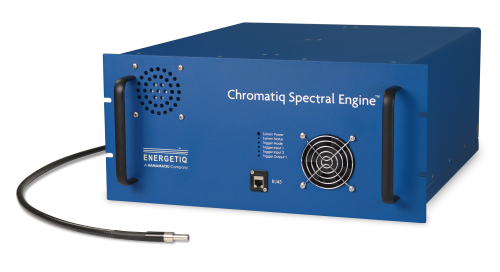
Chromatiq Spectral Engine™

Now featuring extended near-infrared (NIR) wavelengths | 380 nm to 1,100 nm

Chromatiq Spectral Engine CSE_Resized

Extended wavelength range now available.

The Chromatiq Spectral Engine™ (CSE) is a sophisticated light source capable of matching real-world lighting conditions, emulating illuminant standards, and creating custom spectra.

Our award-winning Chromatiq Spectral Engine now features extended near-infrared (NIR) wavelengths that cover the full active range of silicon-based detectors, from 380 nm to 1,100 nm, offering precise alignment between light source and detector.

Features
  • High-fidelity spectral matching
  • Create and combine custom spectra to meet specific requirements
  • Integrate into automated ambient light sensor calibration and testing systems
Models

There are two CSE models available:

  • CSE-EQ-99-VIS
  • [Extended-range] CSE-EQ-99-VIS-NIR

The CSE offers unparalleled spectrum match accuracy as well as repeatability and speed when switching between spectra to optimize optical testing and calibration procedures in the production environment.

The CSE is built around the high radiance and stability of the Laser-Driven Light Source (LDLS®). The performance of the LDLS, combined with the innovative optical design of the CSE system, enables consistent high-fidelity spectrum matching, rapid switching between selected spectra, and stable color content at various intensities. These attributes support the accurate, repeatable, and efficient production of high-end color, image sensors and ambient light sensors.

Performance Specification CSE-EQ-99-VIS CSE-EQ-99-VIS-NIR
Wavelength Range
380 – 780 nm
380 – 1100 nm
Spectral Resolution
< 5 nm
<15 nm
Switching Speed
< 10 ms
< 10 ms
Output Type
6.5 mm liquid light guide

Compare the CSE Models

CSE-EQ-99-VIS
CSE-EQ-99-VIS-NIR

Match Any Spectrum

Extremely fast switching – no settling time between matches.
Check out our virtual demo to see how easy it is to match real-world lighting conditions.


Principle of Operation

Optical design optimized for high-fidelity matching


Fast switching with no setting time.
<10 ms settling time between targeted spectra

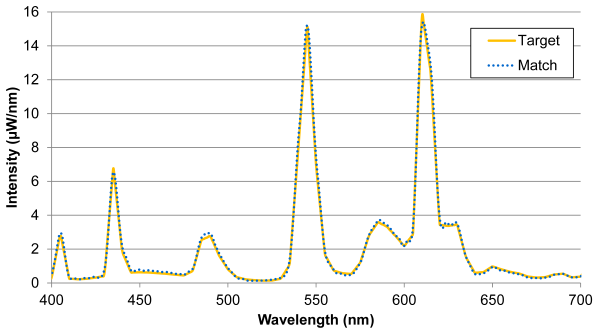
The CSE applies the unique characteristics of the Laser-Driven Light Source (LDLS®), paired with a digital micromirror device (DMD), to enable users to match any kind of light spectrum, including realistic lighting conditions, standard illuminants, combinations of specific lighting sources, and custom spectra.

In contrast to conventional arc lamps, which are operated by running a current through electrodes, an LDLS sustains the emitting plasma by focusing a laser into the light bulb. The result is extremely bright, broadband light from a very small and stable spot. This proprietary technology is at the heart of the CSE, enabling the unmatched spectral resolution, stability, and repeatability of the DMD light source system.

The CSE is spectrum tunable source capable of spectral reproduction, spectral color matching, and has the ability to emulate near-infinite combinations of light sources ranging from incandescent to highly structured light sources, such as CFLs, with extremely fast switching necessary to support high-throughput optical component calibration and ambient light sensor characterization.

Example Match: CIE F12

CIE-F12-Match-Graph

Applications

Color and image sensor calibration and testing

Image sensor development for vehicle perception systems

Color measurement system development and testing

Systems are now available for on-site demonstration.

Schedule a demo to see how CSE or CSE-NIR work in your space.


Request My Meeting

Frequently Asked Questions

What is the lifetime / output degradation of the CSE?

We recommend changing the bulb inside the laser-driven light source that powers the CSE after 10,000 hours of operation.

We define the lifetime of the lamp / bulb as when the intensity has dropped more than 50% at 500 nm. The spectral output at 500 nm decreases about 1% - 2% every 1,000 hours under standard operating conditions with nitrogen purging.

How is the CSE different from the Laser-Driven Tunable Light Source (LDTLS®)?

The LDTLS generates light within a narrow wavelength band. The narrow band can be centered on a single center wavelength, or progressively scanned across a specific wavelength range. The CSE can match any broadband spectrum and can also generate narrow peaks, either single, or multiple. The CSE can provide a narrow-band wavelength sweep. However, if the narrow-band wavelength sweep is all that is needed, the LDTLS will offer better performance in terms of in-band flux. 

Does the CSE require nitrogen purge?

Yes. Energetiq recommends purging with grade of 4.8 nitrogen or higher filtered to 5 μm, to maintain the optics’ cleanliness. Any less nitrogen grade may cause implications for the lamp head optics and could cause a photo-contamination. 

Does the CSE require an external spectrometer?

The CSE Host Application includes an automated system characterization process that adjusts the output of the CSE based on feedback from a calibrated spectrometer. Characterization is typically performed during system installation and periodically thereafter (typically every month or every several months). An individual spectrometer can support a fleet of any number of CSE systems. One of the following spectrometer models is required for characterization. 

 

Is the CSE a laser product?

No. During all normal operation of the CSE, there is no laser output. Our products create incoherent broadband radiation. In a contained system, a laser is used to sustain a xenon plasma and the radiation exiting the CSE is from the plasma.