

Laser-Driven Tunable Light Sources (LDTLS®)
Wavelength Tunable Source Offering High Light Output in a Narrow Band
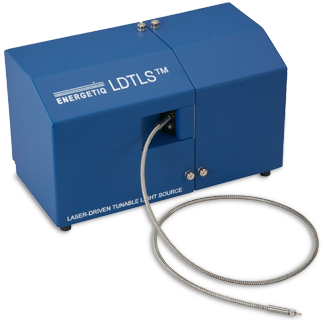
TLS-EQ-9-S
TLS-EQ-77-S
TLS-EQ-77-UV
TLS-EQ-77-NIR
For Sensor Calibration and Continuous, High-Throughput Applications
Energetiq LDTLS® compact light sources let you break free from wavelength constraints for quick, repeatable, and precise measurements across the broadest spectrum.
Built around our Laser-Driven Light Source (LDLS®) technology, the Laser-Driven Tunable Light Source (LDTLS®) gives you access to a wide wavelength range of tunability, high spectral resolution, and an extremely long lifetime with the convenience of fiber-coupled output. The LDTLS features a precision high-performance monochromator for accurate wavelength selection and repeatable light output.
- High spectral radiance for the highest output flux
- Up to 3 mW output power (wavelength dependent ~6.5 nm bandwidth and 1500 µm fiber)
- Low noise, high stability
- 200 nm/second scan speed
- 10,000+ hours of operation
TLS-EQ-77-S Data Sheet
TLS-EQ-77-NIR Data Sheet
TLS-EQ-77-UV Data Sheet
TLS-EQ-9-S Data Sheet
How It Works
TLS-EQ-77-S Demo
Applications
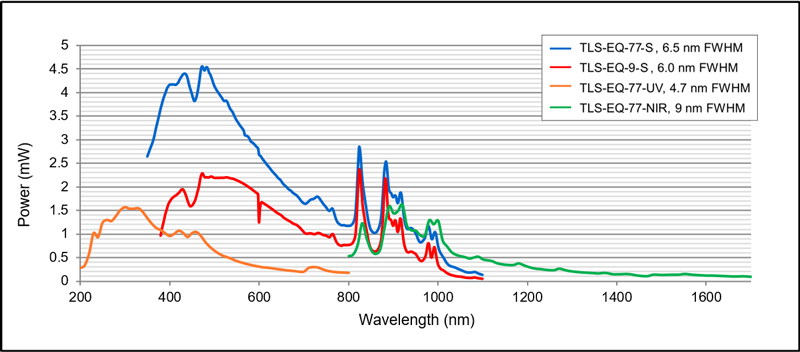
Typical In-Band Flux
| TLS-EQ-9-S | TLS-EQ-77-S | TLS-EQ-77-UV | TLS-EQ-77-NIR | |
|---|---|---|---|---|
|
Wavelength Range
|
380 nm–1100 nm
|
350 nm–1100 nm
|
200 nm – 770 nm
|
800 nm – 1700 nm
|
|
Wavelength Accuracy
|
+/- 0.5 nm
|
+/- 0.5 nm
|
+/- 0.5 nm
|
+/- 0.5 nm
|
|
Scan Speed
|
<20 ms for a 2 nm step
|
<20 ms for a 2 nm step
|
<20 ms for a 2 nm step
|
<20 ms for a 2 nm step
|
|
Standard Optical Output
|
1500 µm core diameter fiber optic cable
|
1500 µm core diameter fiber optic cable
|
600 µm core diameter fiber optic cable
|
1500 µm core diameter fiber optic cable
|
|
Numerical Aperture (NA)
|
0.39
|
0.39
|
0.39
|
0.39
|
|
Spectral Resolution (FWHM)
|
User selectable: 1.0 nm-8.0 nm
|
6.5 nm
|
4.7 nm
|
9 nm
|
|
Laser Class
|
Class 1 (IEC 60825: 2014)
|
Class 1 (IEC 60825: 2014)
|
Class 1 (IEC 60825: 2014)
|
Class 1 (IEC 60825: 2014)
|
|
Maximum In-Band Flux
|
2.37 mW at 824 nm
|
4.9 mW at 400 nm
|
1.6 mW at 300 nm
|
1.62 mW at 920 nm
|
|
Average In-Band Flux
|
~1.20 mW
|
~2.3 mW
|
~1.1 mW (200 nm - 500 nm)
|
~0.44 mW
|
OEM Solutions
With more than a decade of experience in providing advanced high brightness light sources and optical assemblies for light delivery, we have launched a range of systems optimized to meet our OEM customer needs. Our experienced high technology development team of scientists and engineers is eager to partner to provide a custom solution, whatever the application.
Explore Our OEM Solutions
Your exacting system demands are our top concern.
We thrive in working together through the challenges of high brightness, high throughput, and reliable performance in complex systems.

Frequently Asked Questions
What is the lifetime / output degradation of an LDTLS system?
We recommend changing the bulb in an LDTLS system after 10,000 hours of operation or on an annual basis.
We define the lifetime of the lamp / bulb as when the intensity has dropped more than 50% at 500 nm. The spectral output at 500 nm decreases about 1% - 2% every 1,000 hours under standard operating conditions with nitrogen purging.
What is the typical accuracy of the wavelength sweep of the LDTLS systems?
The TLS-EQ-77-S has a typical wavelength accuracy of ± 0.5 nm, while the TLS-EQ-9, TLS-EQ-77-UV, and TLS-EQ-77-NIR have a typical wavelength accuracy of ±1 nm.
How is the LDTLS system/monochromator controlled?
For the TLS-EQ-9-S and TLS-EQ-77 models, we offer a LabVIEW-based PC application that provides a convenient user interface to allow the customer to control the system. We also provide Dynamic Link Library (*.dll) files that allow the user to develop their own controls. The system interfaces with Windows operating system through a Mini USB connector.
The LDTLS system can be used in two modes: go-to-wavelength or cycle/sweep. The user is also able to adjust the filter wheel transition for the order sorting filter.
Do the LDTLS systems require nitrogen purge?
We recommend purging using a grade of 4.8 nitrogen or higher filtered to 5 μm to maintain the optics’ cleanliness. Any lower nitrogen grade may cause complications for the lamp head optics and could cause a photo-contamination. Nitrogen purging of the EQ-77 lamp head is particularly important for the TLS-EQ-77-UV to maintain UV output.
Are LDTLS systems laser products?
No. During all normal operation of the LDTLS system, there is no laser output. Our products create incoherent broadband radiation. In a contained system, a laser is used to sustain a xenon plasma. The radiation exiting the LDTLS system is from the plasma.