

Your exacting system demands are our top concern.
We thrive in working together through the challenges of high brightness, high throughput, and reliable performance in complex systems.

Frequently Asked Questions
What is the lifetime / output degradation of the LDLS?
We recommend changing the bulb after 10,000 hours of operation.
We define the lifetime of the lamp / bulb as when the intensity has dropped more than 50% at 500 nm. The spectral output at 500 nm decreases about 1% - 2% every 1,000 hours under standard operating conditions with nitrogen purging.
What are the options for the output window material of the LDLS? What window type is right for my application?
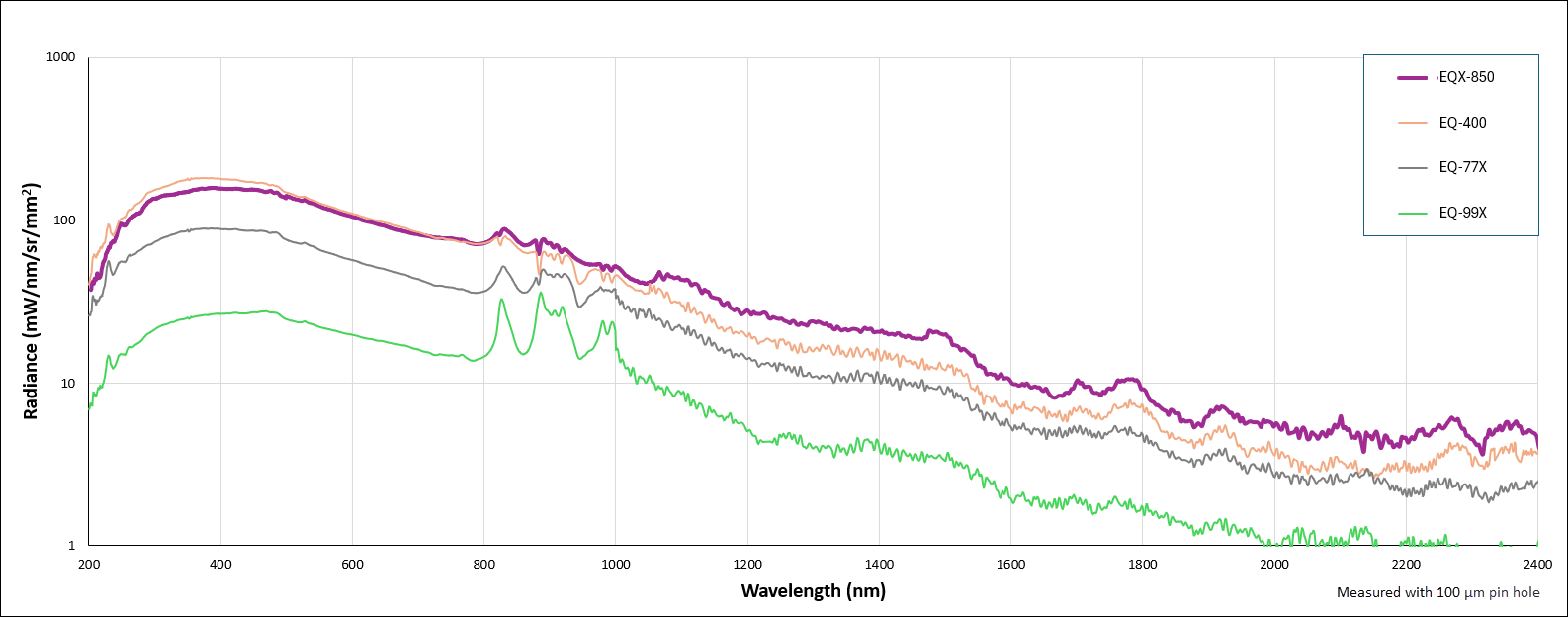
The EQ-99X, EQ-9, EQ-77X, EQ-400, and EQX-850 have a spectral range of 170 nm to 2500 nm.
Window selection is typically influenced by the effect of ultraviolet light on your application. The standard configuration for all LDLS models is with a quartz (QZ) output window. For applications that suffer from UV exposure, YAG and BK7 windows offer the benefit of filtering out energy from 170 nm to 190 nm and 170 nm to 350 nm, respectively. MgF windows are ideal for applications that benefit from enhanced deep-UV radiance from 170 nm to 200 nm.
What is the total broadband optical power of the LDLS?
LDLS Model | Broadband Optical Power*
EQ-99X — 0.75 W
EQ-9 — 0.5 W
EQ-77X — 2.75 W
EQ-400 —15 W
EQ-99X-FC — 95 mW**
EQX-850 – 2.75 W
*Measured with thermophile
**UVFIBERX-230 fiber optic cable
Is it possible to purchase an LDLS with a dual output?
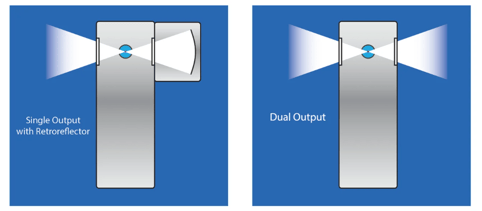
The EQ-9, EQ-77X, EQ-400, and EQ-850 can be purchased without a retroreflector, allowing for a dual output configuration. Please email us at info@energetiq.com to connect with an Applications Engineer who can help you determine if this configuration suits your application.
Is there a fiber-coupled version of the LDLS?
Yes, the EQ-99X-FC is a fiber-coupled version of the EQ-99X free space LDLS. Energetiq sells two types of fibers for use with the EQ-99X-FC LDLS. They are UV-Vis Solarization Resistant (UV) and Broadband (BB).
When do I need to purge the LDLS?
For the EQ-99X, EQ-99X-FC, EQ-9, and EQ-77X systems, it is recommended to purge the LDLS with dry nitrogen while operating. For the EQ-400 and EQX-850 systems, it is required to purge with nitrogen while operating .
LDLS products emit significant amounts of deep UV light. Light below 200 nm produces ozone in the presence of oxygen, and the ozone produced has an absorption band in the 220 nm to 280 nm range. To use light from the LDLS in the 170 to 280 nm range, the system should be purged with high purity nitrogen. Purging with high purity nitrogen also reduces the possibility of photo-contamination of the bulb from trace organic vapors present in room air.
Are LDLS laser products?
No. During all normal operation of LDLS there is no laser output. Our products create incoherent broadband radiation. In a contained system, a laser is used to sustain a xenon plasma and the radiation exiting the LDLS is from the plasma.