

Frequently Asked Questions
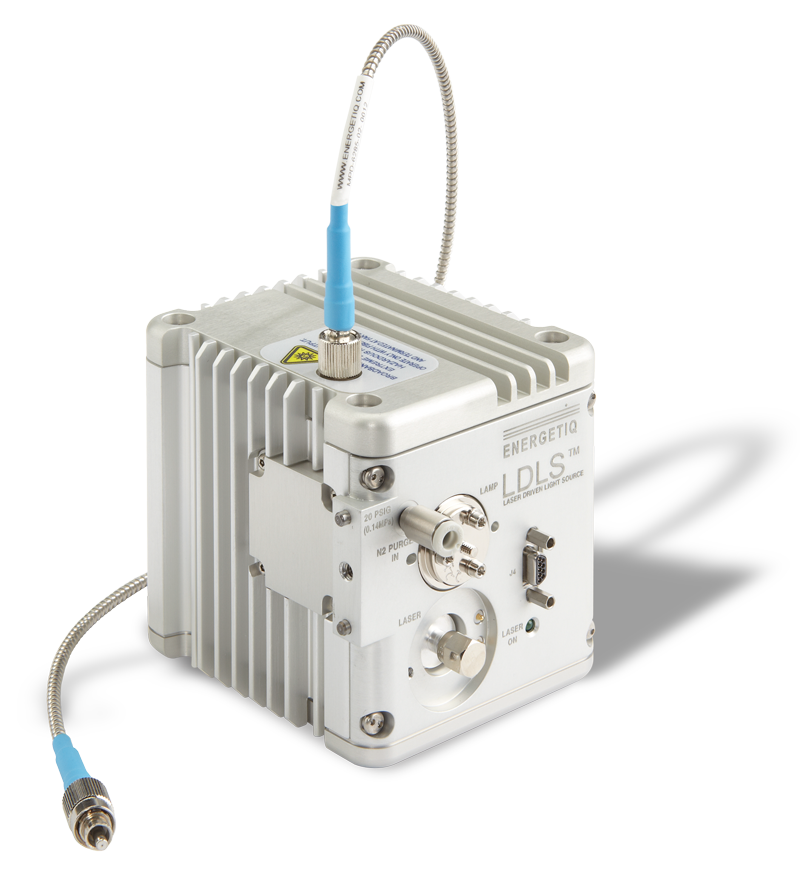
Is there a fiber-coupled version of the LDLS?
Yes, the EQ-99X-FC is a fiber-coupled version of the EQ-99X free-space LDLS. Energetiq sells two types of fibers for use with the EQ-99X-FC LDLS. They are UV-Vis Solarization Resistant (UV) and Broadband (BB).
What is the difference between UV-Vis Solarization Resistant (UV) and Broadband (BB) fibers?
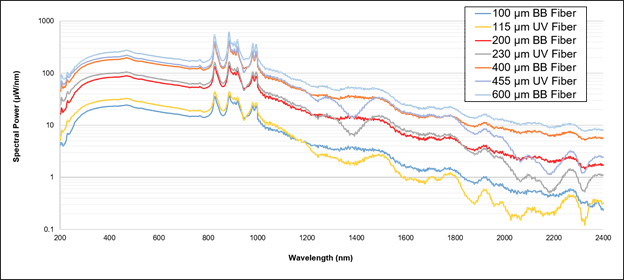
Both the UV-Vis and Broadband fibers transmit from 190 nm to 2500 nm. However, the UV-Vis fibers are constructed using high OH material and are engineered to withstand ultraviolet solarization. They provide higher output from 190 nm to 900 nm when compared to Broadband fibers of comparable core size.
The UV fibers are ideal for applications benefiting from enhanced radiance from 190 nm – 350 nm and the BB fibers are preferable for applications that benefit from enhanced radiance from 350 nm to 2500 nm.
What is the fiber output termination?
All fibers connect to the lamphead via FC connection and are available with either SMA or FC output termination. The user can select the termination for the output end of the fiber according to their application requirements.
How do I select the correct fiber for my application?
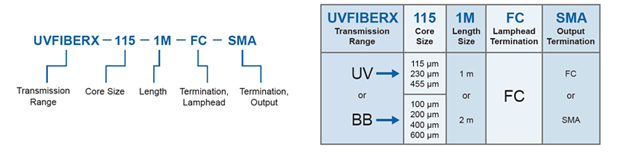
First you must select either the UV-Vis or Broadband fiber type as described above. For each fiber type there are multiple core size options. Every fiber is available at 1 or 2 meter of length and are available with either SMA or FC output termination. Reference the Fiber Optic Cable Assemblies data sheet for additional information.
For instance, the UVFIBERX-115-1M-FC-SMA is a UV-Vis fiber with a 115 μm core size, 1 meter length and SMA output termination.
Is it possible to use non-Energetiq fibers to couple the EQ-99X-FC LDLS?
Our proprietary fibers must be used with the EQ-99X-FC. Using off-the-shelf, commercially available fibers can cause damage to the lamp head and are not approved for use with the LDLS.
What is the numerical aperture of the fibers? Is the fiber PC or APC? Is the fiber narrow key or wide key?
All EQ-99X-FC fibers have a numerical aperture (NA) of 0.22, and are PC type with narrow key.
Is there a limit on the output fiber length from the lamp head to the application?
For both the UV resistance and broadband fibers, Energetiq offers one- and two-meter-long fibers. Since even the best optical fibers absorb light in the deep UV, it is recommended to use the shortest fiber length possible to maximize the potential of the LDLS. EQ is able to offer custom fiber lengths upon request.
Innovate With Us.
We’re ready to collaborate on your next project.
